Grid: mobility × channel
Varies: mobility model (rwp, ssrwp, gaussmarkov) × channel model
(tworay, nakagami) — six cells at the paper base scenario.
← Benchmark index · Metrics · Methodology
Provenance — measured at
dd171e5e, the #496 timer fix in place (TimerJitter = 0.05,ReconvHoldCap = 200 ms). This is the #496 re-baseline. PR #497 (43dd2f96) desynchronised the ns-3 adapter's hello and proactive timers. Before it, every node beaconed at the same instant every second, hidden terminals collided on those broadcasts, and two consecutive lost hellos evicted a live neighbour. That is a protocol-behaviour change, so it superseded the previous version of this page under the provenance rule. All six cells were re-measured onmainatdd171e5e, which carries the496 code plus documentation commits only. **The oracle now runs in the same
dispatch** as the four protocols, so every column on this page comes from one run per cell.
The attribution control is the oracle, not the baselines. The per-seed logs of the last pre-#496 grid (the #431 re-measure at
4611bbb) have expired, so a byte-level baseline comparison is no longer possible. What survives is #431's per-cell table. The oracle, which runs no AntHocNet code, reproduces it in 6 / 6 cells (to the printed digit in five, 0.01 pp in the sixth). So no harness, seed or channel change separates the two corpora, and AntHocNet's movement is attributable to #496 alone. See the attribution control.The two previous versions stay in git history and remain valid as evidence of their own operating points:
a1daa7a(v1.5.0 phase 1, 200 ms cap, unjittered timer):git show 0caa508d:docs/benchmarks/grid.md;4cdfb96(1 s cap):git show v1.4.0:docs/benchmarks/grid.md.The per-seed cells are committed as
cells/grid-<mobility>-<channel>.txt.OLSR's delivery column is restated (#510). Stock ns-3 OLSR refuses an unroutable send at the source:
RouteOutputreturns no route, the socket send fails, and FlowMonitor never counts the packet. So OLSR's PDR left those sends out of its denominator. This is the oracle's #464 defect, in the one real arm that shares it. PR #511 counts them. The OLSR column below comes from a 20-seed OLSR-only re-run of each cell on the fix (bd1f4e49).The re-runs reproduce every other OLSR column byte-for-byte. Only PDR, the offered-load percentiles and the drop book move. The new PDR matches the delivered-bytes estimate from the original dispatch to ≤ 0.18 pp per seed. OLSR reads 1.96–5.16 pp lower than published, and the other three protocols and the oracle are unaffected.
One ordering changes. In gaussmarkov-tworay, AODV now leads OLSR, by +1.85 pp [+1.25, +2.45] (p = 2.7 × 10⁻⁴, 19/20 seeds). The delivery ordering is no longer the same in all six cells; see the ranking-stability statement.
Cells:
cells/grid-<mobility>-<channel>-olsr510.txt, runs36962722070…36962733439.
Restated on CBR sources (#521)
All six cells were re-measured on constant-bit-rate sources. Until #521 every source ran ns-3's default 1 s on / 1 s off, so each flow was offered 0.5 pkt/s, not the stated 1 pkt/s.
Provenance. Six
paper-benchmark.ymldispatches atmain@d26ae640(the #524 merge), image3.42-opt, 20 seeds, 900 s, five arms. Knobs are identical to thedd171e5edispatches below:
mobility channel run rwp tworay 37169506292 ssrwp tworay 37169507825 gaussmarkov tworay 37169509243 rwp nakagami 37169510406 ssrwp nakagami 37169511723 gaussmarkov nakagami 37169513137
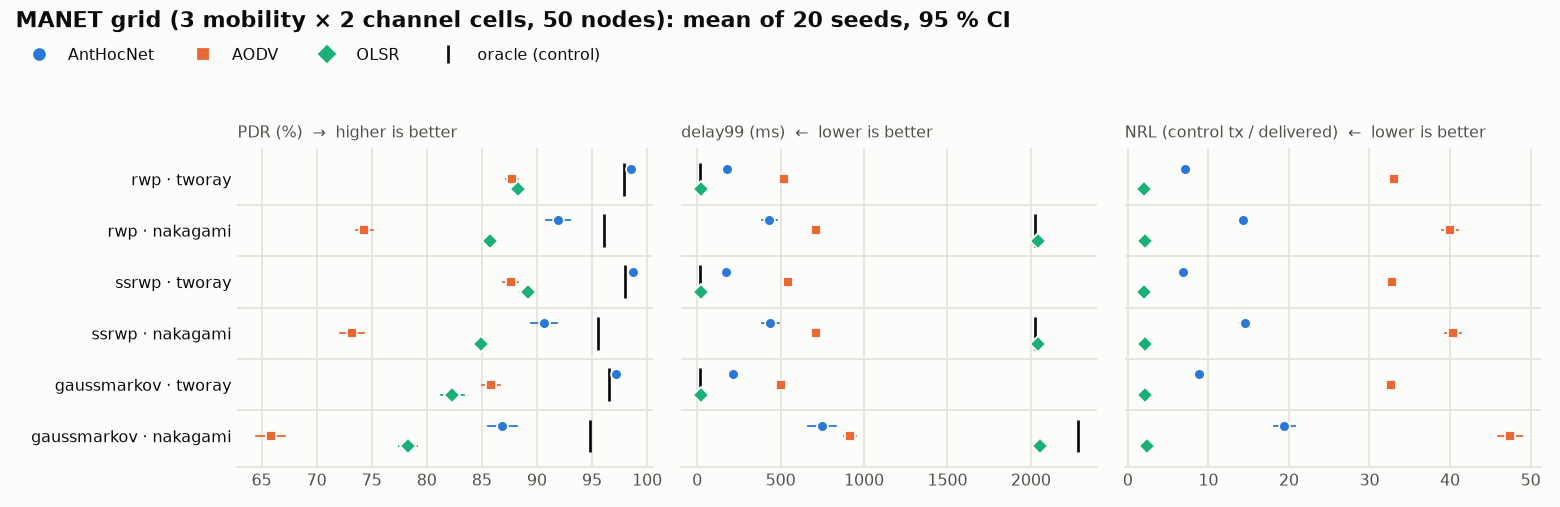
Dots: mean of 20 seeds; whiskers: 95 % CI (t for PDR and NRL, bootstrap for delay99); black tick: the oracle control,
approx=1on these channels (#431: its delay99 is not a bound on Nakagami). DSDV is in the cells and tables, not plotted, to keep three series apart. Drawn byns3/tools/family-charts.pyfrom the committed cellsgrid-*-cbr521.txt.Cells:
cells/grid-<mobility>-<channel>-cbr521.txt. Each marker carries 20 rows per arm. Rows split by the workflow's interleaved##RSS##line are dropped; their clean re-emitted copies are kept.bench_parsecolumn mapping is OK (25 checks) on all six. Statistics come fromstats_util.
scenario_check.py results: - the two-ray cells are WARN-only; - the Nakagami cells FAIL only on the known #431 hop residual (8 / 12 / 15 seeds, against 8 / 15 / 17 before).One more FAIL fired on two Nakagami cells, from the #464 "refusals with route=0.00" gate. It was a display-precision false positive: 5 and 3 booked refusals over ~340k offered packets print as 0.00. The gate now FAILs only when the share would print (≥ 0.005 %). That fix lands in this PR, with a test.
OLSR's PDR is offered-based (#510). AntHocNet's hop columns predate the
522 TTL compensation (
ba25a458); no number quoted here uses them.¶Delivery — PDR %, mean ± 95 % CI:
mobility channel anthocnet aodv olsr dsdv oracle rwp tworay 98.52 ± 0.18 87.71 ± 0.56 88.31 ± 0.59 84.73 ± 0.79 97.93 ± 0.21 ssrwp tworay 98.68 ± 0.18 87.61 ± 0.65 89.16 ± 0.71 86.06 ± 0.77 98.02 ± 0.23 gaussmarkov tworay 97.22 ± 0.20 85.84 ± 0.78 82.31 ± 1.04 78.79 ± 1.12 96.54 ± 0.38 rwp nakagami 91.90 ± 1.06 74.31 ± 0.77 85.72 ± 0.49 72.35 ± 1.15 96.09 ± 0.47 ssrwp nakagami 90.66 ± 1.18 73.20 ± 1.06 84.90 ± 0.56 71.94 ± 1.35 95.55 ± 0.48 gaussmarkov nakagami 86.86 ± 1.33 65.83 ± 1.29 78.28 ± 0.78 63.48 ± 1.35 94.82 ± 0.42 Overhead — NRL, mean ± 95 % CI:
mobility channel anthocnet aodv olsr dsdv oracle rwp tworay 7.10 ± 0.17 32.99 ± 0.54 2.01 ± 0.02 11.56 ± 0.11 0.00 ± 0.00 ssrwp tworay 6.79 ± 0.15 32.85 ± 0.46 1.99 ± 0.02 11.35 ± 0.11 0.00 ± 0.00 gaussmarkov tworay 8.80 ± 0.21 32.73 ± 0.60 2.17 ± 0.03 12.52 ± 0.18 0.00 ± 0.00 rwp nakagami 14.32 ± 0.53 39.98 ± 0.97 2.17 ± 0.02 13.82 ± 0.27 0.00 ± 0.00 ssrwp nakagami 14.56 ± 0.66 40.35 ± 0.98 2.18 ± 0.02 13.87 ± 0.33 0.00 ± 0.00 gaussmarkov nakagami 19.44 ± 1.31 47.44 ± 1.46 2.39 ± 0.03 15.98 ± 0.40 0.00 ± 0.00 Tail —
delay99ms, mean with bootstrap 95 % interval:
mobility channel anthocnet aodv olsr dsdv oracle rwp tworay 175.9 [172.1, 179.9] 523.0 [510.1, 536.8] 20.8 [20.2, 21.3] 381.7 [350.8, 414.4] 17.8 [17.4, 18.1] ssrwp tworay 172.3 [168.9, 176.1] 544.0 [525.0, 563.9] 20.9 [20.1, 21.9] 409.9 [365.1, 482.1] 17.2 [16.9, 17.5] gaussmarkov tworay 216.8 [210.1, 224.7] 501.2 [488.9, 514.0] 22.1 [21.2, 22.9] 389.6 [334.8, 469.2] 19.4 [19.1, 19.9] rwp nakagami 429.1 [389.1, 475.4] 710.1 [688.8, 735.3] 2039.8 [2035.3, 2044.5] 1848.2 [1691.5, 1974.7] 2025.6 [2021.3, 2030.7] ssrwp nakagami 438.1 [388.3, 488.4] 713.0 [691.6, 733.8] 2041.8 [2036.9, 2046.5] 1887.5 [1743.6, 2009.9] 2026.0 [2022.5, 2030.3] gaussmarkov nakagami 750.0 [669.5, 833.4] 914.4 [878.0, 950.3] 2057.0 [2050.3, 2064.4] 2039.5 [2032.0, 2047.5] 2282.9 [2155.1, 2428.2] AntHocNet vs AODV, paired per seed (t-CI for PDR and NRL, bootstrap for
delay99):
mobility channel ΔPDR (pp) ΔNRL Δdelay99 (ms) rwp tworay +10.81 [+10.33, +11.28] -25.89 [-26.42, -25.37] -347.10 [-360.80, -334.25] ssrwp tworay +11.08 [+10.40, +11.75] -26.06 [-26.53, -25.59] -371.75 [-391.55, -352.55] gaussmarkov tworay +11.38 [+10.64, +12.12] -23.93 [-24.41, -23.44] -284.35 [-292.65, -275.70] rwp nakagami +17.59 [+16.54, +18.64] -25.66 [-26.40, -24.92] -281.05 [-319.00, -235.70] ssrwp nakagami +17.46 [+16.23, +18.69] -25.79 [-26.57, -25.00] -275.00 [-321.45, -227.25] gaussmarkov nakagami +21.04 [+20.07, +22.00] -28.00 [-28.82, -27.19] -164.35 [-225.60, -103.00] max p 0.0005519796434053147 What holds: - AntHocNet beats AODV on all three metrics in all six cells. Every interval excludes zero; the largest Wilcoxon p is 5.5 × 10⁻⁴ (it was ≤ 9.6 × 10⁻⁵). - AntHocNet leads delivery in every cell. - The AODV–OLSR order is the same. AODV is ahead in gaussmarkov-tworay (+3.52 pp [+2.91, +4.14], 20/20 seeds). OLSR is ahead in the other five, narrowly in rwp-tworay (+0.59 pp [+0.22, +0.97], p = 0.0062). - The tail ranking is the same: - two-ray: OLSR best, AntHocNet second; - Nakagami: AntHocNet best and OLSR worst. In gaussmarkov-nakagami OLSR reads 2057.0 [2050.3, 2064.4] against DSDV's 2039.5 [2032.0, 2047.5].
What changes: - On two-ray, AntHocNet delivers more than the oracle: +0.58 / +0.66 / +0.67 pp, on 17 / 19 / 16 of 20 seeds (p ≤ 0.004). Before #521 it sat 0.23–1.09 pp below. - The two-ray oracle is
approx=1: it routes over the PHY's decode-radius disk and is blind to link quality. - At the full offered load, its long decode-edge links lose 1.50–2.55 % at the MAC retry limit. Its PDR barely moves (98.09 → 97.93 % in rwp-tworay). - AntHocNet's own losses fell under CBR (route 1.41 → 0.90 % in rwp-tworay), and its total is now below the oracle's MAC loss alone. - So the oracle's delivery is not a bound on the two-ray cells at this load. The quoting rule narrows: delivery is a bound on the Nakagami cells only. There the oracle still leads AntHocNet by 4.19–7.96 pp on every seed. - Quote the two-ray result as "AntHocNet beats the hop-count, link-blind oracle". The words "the bound" do not apply to it. - The overhead ordering is no longer the same everywhere. - Two-ray is unchanged:olsr < anthocnet < dsdv < aodv. - Under Nakagami DSDV's NRL is below AntHocNet's:olsr < dsdv < anthocnet < aodv, by +0.50 / +0.69 / +3.46 (p ≤ 0.015). - Why: with twice the data, NRL falls ×0.50 for OLSR and DSDV, whose periodic control does not depend on the data. AntHocNet's falls only ×0.58 / ×0.58 / ×0.63 on Nakagami (×0.53 on two-ray). That is consistent with part of its control (reactive and repair ants after fading losses) scaling with the data it carries. That mechanism is not measured here. - NRL roughly halves for every routing arm: the same periodic control now carries twice the data (ratios above).The sections below are the dated pre-#521 record (
dd171e5e). Where they disagree with this block, this block is current.
What it varies
The v1.4.0 exit criteria ask for a headline grid under ≥2 mobility models × ≥2 channel models with a ranking-stability statement. This is that grid, re-established at the v1.5.0 default.
The axes are deliberately built as controlled contrasts rather than as a collection of unrelated models:
- Mobility (#61) —
rwpis the original evaluation's Random Waypoint;ssrwpis the same model started from its stationary distribution, sorwpvsssrwpisolates the speed-decay transient alone;gaussmarkovis the qualitatively different model (smooth correlated tracks).pauseis inert under Gauss-Markov and is set to 0 there — preflight FAILs any other value. - Channel (#60) —
nakagamistacks Nakagami-m fading on the same two-ray path loss used by thetworayarm, so the pair isolates fading alone. Therangedisk model is deliberately not one of the two: it is a propagation abstraction with no fading and no distance-dependent loss curve, so counting it would satisfy the criterion's letter while leaving its motivation untouched.
How it is produced
Six manual paper-benchmark.yml dispatches, one per cell — not the
per-merge benchmarks workflow and not scenario-matrix.yml. Each cell runs
the paper base scenario (50 nodes, 1500 × 300 m, 900 s, 20 CBR flows) at
20 seeds, with all four protocols on identical realisations inside that
cell. Phase 3 repeated the same six dispatches with the oracle control added as
a fifth arm — same scenario, same 20 seeds, same
#352-pinned RNG streams
(the oracle evaluates no propagation model, so it draws from none of them).
Because the cells come from independent dispatches rather than one classified
sweep, this page has no generated block: the tables below are
hand-written, as on the satellite suite page. The
per-seed data behind them is committed next to this page as
cells/grid-<mobility>-<channel>.txt (##RUN##, ##BENCH##, ##CONFIG##,
##PROV##, ##ORACLE##, ##COMMON##, ##MATCH##, # drops, # stddev).
Each cell's ##PROV## line pins commit=dd171e5e, and its ##CONFIG## pins
TimerJitter=0.05 and ReconvHoldCap=+2e+08ns, so every block is
self-describing. The committed
../benchmarks/campaign/pooled-grid-mobility-channel-20260808.csv and its
per-run sibling remain the 1 s corpus, superseded twice over.
Results
The oracle column is a reference point rather than a competitor; how far each of its columns may be read as a bound is settled in the quoting rule.
Delivery — PDR %, mean ± 95 % CI
| mobility | channel | anthocnet | aodv | olsr (#510) | dsdv | oracle |
|---|---|---|---|---|---|---|
| rwp | tworay | 97.78 ± 0.22 | 85.48 ± 0.70 | 88.41 ± 0.57 | 84.64 ± 0.82 | 98.08 ± 0.16 |
| ssrwp | tworay | 97.97 ± 0.23 | 86.23 ± 0.41 | 89.38 ± 0.70 | 85.62 ± 0.84 | 98.20 ± 0.22 |
| gaussmarkov | tworay | 95.59 ± 0.34 | 84.17 ± 0.88 | 82.32 ± 1.11 | 78.64 ± 1.16 | 96.69 ± 0.31 |
| rwp | nakagami | 91.50 ± 0.90 | 73.57 ± 0.91 | 85.36 ± 0.67 | 72.57 ± 1.24 | 96.92 ± 0.39 |
| ssrwp | nakagami | 91.10 ± 0.86 | 72.69 ± 1.27 | 84.98 ± 0.56 | 71.92 ± 1.26 | 96.53 ± 0.59 |
| gaussmarkov | nakagami | 88.11 ± 0.71 | 66.65 ± 1.16 | 78.39 ± 0.80 | 63.89 ± 1.13 | 95.99 ± 0.35 |
OLSR's column is offered-based (#510). The pre-#510 values were 90.62, 91.34, 86.00, 87.74, 87.36 and 83.55.
Overhead — NRL, mean ± 95 % CI
| mobility | channel | anthocnet | aodv | olsr | dsdv | oracle |
|---|---|---|---|---|---|---|
| rwp | tworay | 13.46 ± 0.25 | 66.22 ± 1.11 | 4.03 ± 0.03 | 23.17 ± 0.21 | 0.00 ± 0.00 |
| ssrwp | tworay | 12.97 ± 0.30 | 65.26 ± 0.94 | 3.97 ± 0.04 | 22.82 ± 0.25 | 0.00 ± 0.00 |
| gaussmarkov | tworay | 16.69 ± 0.47 | 64.41 ± 1.74 | 4.36 ± 0.06 | 25.09 ± 0.40 | 0.00 ± 0.00 |
| rwp | nakagami | 24.86 ± 0.58 | 78.10 ± 1.83 | 4.35 ± 0.06 | 27.57 ± 0.57 | 0.00 ± 0.00 |
| ssrwp | nakagami | 25.16 ± 0.84 | 79.13 ± 2.38 | 4.35 ± 0.05 | 27.76 ± 0.63 | 0.00 ± 0.00 |
| gaussmarkov | nakagami | 30.78 ± 0.70 | 87.69 ± 2.40 | 4.76 ± 0.06 | 31.73 ± 0.59 | 0.00 ± 0.00 |
Tail — delay99 ms, mean with bootstrap 95 % interval
| mobility | channel | anthocnet | aodv | olsr | dsdv | oracle |
|---|---|---|---|---|---|---|
| rwp | tworay | 203.7 [197.1, 210.7] | 605.5 [579.7, 631.0] | 24.4 [22.8, 26.9] | 618.4 [496.6, 748.8] | 19.8 [19.5, 20.1] |
| ssrwp | tworay | 195.3 [187.2, 204.2] | 593.5 [570.5, 617.5] | 22.9 [22.4, 23.7] | 561.5 [453.5, 685.6] | 19.4 [19.1, 19.8] |
| gaussmarkov | tworay | 302.5 [281.6, 324.0] | 578.9 [552.5, 607.2] | 58.2 [24.0, 125.2] | 618.8 [496.2, 747.5] | 21.4 [21.0, 21.7] |
| rwp | nakagami | 369.4 [335.0, 410.1] | 849.2 [814.0, 888.8] | 2442.9 [2255.6, 2634.9] | 2032.5 [2027.3, 2038.2] | 2170.6 [2073.3, 2297.8] |
| ssrwp | nakagami | 386.2 [345.3, 432.0] | 842.7 [802.5, 883.4] | 2646.7 [2464.3, 2820.8] | 2085.3 [2032.8, 2184.9] | 2236.2 [2090.2, 2416.4] |
| gaussmarkov | nakagami | 596.9 [539.0, 661.9] | 1059.5 [1014.6, 1111.5] | 2974.5 [2902.1, 3011.8] | 2384.8 [2215.6, 2562.4] | 3009.6 [3008.3, 3010.8] |
A t-interval on a per-run p99 is not defensible, so the tail uses a
percentile bootstrap (policy). The
oracle's fading-cell tail is not a bound and must not be read against the
other arms; see
metrics.md.
AntHocNet vs AODV — paired, per seed
Both protocols run on identical realisations inside a cell, so this is a
paired difference (t-CI for PDR/NRL, bootstrap for delay99, two-sided
Wilcoxon). This is the test of record; the per-arm intervals above are for
orientation.
| mobility | channel | ΔPDR (pp) | ΔNRL | Δdelay99 (ms) |
|---|---|---|---|---|
| rwp | tworay | +12.30 [+11.62, +12.98] | -52.76 [-53.89, -51.63] | -401.90 [-425.15, -377.55] |
| ssrwp | tworay | +11.74 [+11.33, +12.15] | -52.28 [-53.33, -51.24] | -398.15 [-421.15, -377.30] |
| gaussmarkov | tworay | +11.42 [+10.63, +12.21] | -47.71 [-49.19, -46.23] | -276.35 [-307.00, -245.75] |
| rwp | nakagami | +17.93 [+16.72, +19.13] | -53.24 [-54.95, -51.54] | -479.75 [-527.30, -430.30] |
| ssrwp | nakagami | +18.41 [+17.57, +19.25] | -53.97 [-55.93, -52.01] | -456.50 [-494.05, -420.65] |
| gaussmarkov | nakagami | +21.46 [+20.13, +22.80] | -56.91 [-59.37, -54.46] | -462.60 [-527.90, -404.30] |
AntHocNet beats AODV on all three metrics in all six cells, every interval excluding zero, every p ≤ 9.6 × 10⁻⁵ (18 comparisons; at α = 0.05 that is ~0.9 expected false positives, and the largest p here is about 500× below α). That is new: before #496 the tail was the marginal column. AODV held a paired edge of +81 / +73 ms (p = 0.012 / 0.033) in the rwp and ssrwp fading cells, and gaussmarkov-nakagami was a tie (p = 0.7). Those edges now read −480 / −457 / −463 ms.
Old → new: what the #496 timer fix bought, per cell
AntHocNet only.
- Pre-#496 PDR is #431's per-cell table at
4611bbb: the last grid before the fix, on the same harness, oracle and seeds. - Pre-#496 NRL and
delay99come from the previous version of this page ata1daa7a, because #431 did not republish them.a1daa7apredates the #459 flow-start fix, which moved AntHocNet's PDR by 0.1–0.5 pp (a1daa7a→4611bbbcolumn). So the NRL anddelay99deltas are #496 plus a small #459 share.
| mobility | channel | PDR a1daa7a |
PDR 4611bbb → now (Δpp) |
NRL a1daa7a → now |
delay99 a1daa7a → now |
|---|---|---|---|---|---|
| rwp | tworay | 92.58 | 92.11 → 97.78 (+5.67) | 34.92 → 13.46 | 420.8 → 203.7 (−52 %) |
| ssrwp | tworay | 92.95 | 92.42 → 97.97 (+5.55) | 34.37 → 12.97 | 373.3 → 195.3 (−48 %) |
| gaussmarkov | tworay | 90.08 | 89.83 → 95.59 (+5.76) | 36.65 → 16.69 | 512.8 → 302.5 (−41 %) |
| rwp | nakagami | 89.78 | 89.64 → 91.50 (+1.86) | 46.89 → 24.86 | 920.0 → 369.4 (−60 %) |
| ssrwp | nakagami | 89.54 | 89.48 → 91.10 (+1.62) | 46.88 → 25.16 | 890.6 → 386.2 (−57 %) |
| gaussmarkov | nakagami | 85.87 | 85.58 → 88.11 (+2.53) | 52.44 → 30.78 | 1022.9 → 596.9 (−42 %) |
The fix bought on every axis at once. The 200 ms ReconvHoldCap flip
traded delivery for tail; #496 removes the spurious link breaks the hold was
covering for, so it does not trade at all:
- delivery rises +1.6 to +5.8 pp;
- overhead falls by roughly half (−20 to −22 NRL);
- the tail falls 41–60 %.
Two-ray gains the most delivery: AntHocNet now sits 0.23–1.09 pp below the oracle there. Fading gains the most tail. Under Nakagami the channel itself still costs 3–4 pp (oracle 96.0–96.9 %), and AntHocNet's remaining gap to the oracle is 5.4–7.9 pp.
The attribution control: the oracle reproduces #431 in 6/6 cells
The pre-#496 per-seed logs (#431's runs 32209168271 … 32209193038) have
expired (HTTP 410) and left no artifacts, so the byte-identical baseline
comparison this page used to carry cannot be repeated. The control that
remains:
| cell | oracle PDR, #431 at 4611bbb |
oracle PDR, now |
|---|---|---|
| rwp / tworay | 98.08 | 98.08 |
| ssrwp / tworay | 98.20 | 98.20 |
| gaussmarkov / tworay | 96.69 | 96.69 |
| rwp / nakagami | 96.92 | 96.92 |
| ssrwp / nakagami | 96.53 | 96.53 |
| gaussmarkov / nakagami | 96.00 | 95.99 |
The last row differs by 0.01 pp (95.99 here against #431's 96.00); every other row matches to the printed digit.
Why this control works. The oracle runs no AntHocNet code and evaluates no propagation model. Its delivery depends only on:
- the mobility and fading realisations;
- the flow schedule;
- the PHY-derived radius.
Reproducing #431 in every cell therefore shows that none of those moved
between 4611bbb and dd171e5e. The only routing-relevant code change in
that range is #497. This is weaker than a per-seed byte match: it is
aggregate-level, and it does not cover the three baselines directly. It is,
however, essentially exact on the one arm that cannot be influenced by
AntHocNet.
Do not compare these baselines with the a1daa7a version of this page.
The #459 flow-start fix
landed between the two and moved every arm by a few tenths of a point. For
example, aodv rwp-tworay reads 85.92 there and 85.48 here.
The hop-bound FAILs are the known #431 class. scenario_check results
FAILs only on the three Nakagami cells, all on the known #431 fading residual
(oracle identity-matched hops above dsdv's on the ##COMMON## set), on 8, 15
and 17 of 20 seeds. #431 recorded 6, 13 and 15. The common set is the packets
every arm delivered, AntHocNet included, so a changed AntHocNet changes that
set; the residual itself is the oracle's median-radius approximation and is
unchanged in kind. The two-ray cells are WARN-only (the approximate-oracle
notes).
The oracle control — how much of the shortfall is routing?
This is the question the four-arm grid above cannot answer and the reason
phase 3 exists. Every table
so far compares protocols to each other; none of them says how much of the
distance to perfect is protocol overhead and how much is the channel. The
oracle — global-knowledge Dijkstra over the ground-truth topology, replayed as
an Ipv4RoutingProtocol, emitting no control traffic whatsoever
(#415; framing in
methodology.md) — is the
arm that makes the split measurable.
Read this section as the v1.5.0 phase-3 record, measured before #496. The analysis below (the composition argument, the per-cell oracle table, the gap decomposition and the caveat) was measured at
40b434d/4611bbb. In that version the oracle was a separate dispatch beside thea1daa7afour-arm grid, and AntHocNet still had the unjittered timer. Its oracle-side findings still stand, because the oracle's own numbers are reproduced exactly above. Its AntHocNet-side figures do not: AntHocNet's routing gap to the oracle is now
- 0.23–1.09 pp on two-ray (it was 5.8–6.9 pp at
4611bbb);- 5.4–7.9 pp under Nakagami (it was 7.1–10.4 pp).
The current oracle column is in the Results tables, measured in the same dispatch as every other arm.
Why the oracle columns compose with the tables above
The oracle cells are a different dispatch at a different commit (40b434d,
which adds contrib/oracle) from the four-arm tables (a1daa7a). Quoting a
column measured at one commit inside a table measured at another is exactly the
provenance-rule
violation this repo re-baselines corpora to avoid — so the composition needs a
control, and it has one:
480 ##RUN## rows byte-identical. Every per-seed row of all four original
arms — 6 cells × 4 protocols × 20 seeds — is byte-for-byte identical between
the phase-1 and phase-3 blocks, as are the ##BENCH##, # stddev, # paths,
# drops and # energy lines. AntHocNet included: the subject under test
did not move by a single printed digit when the fifth arm was added. Adding the
oracle therefore perturbed nothing measurable — same seeds, same realisations,
same scheduler order for the arms that were already there — and the oracle
column is a measurement of the same six cells, not of a neighbouring
configuration. This is the same class of control as the
0/18 attribution control of the pre-#496 version of this page, applied to an added arm rather than to a changed default, and it is the
reason the rest of this section is legitimate rather than merely convenient.
Two structural facts back it up: the oracle module is off unless --protocols
names it, and it evaluates no propagation model at all, so it takes no draw
from the channel's #352-pinned
RNG stream and every other arm sees the identical fading realisation it saw in
phase 1.
The oracle arm, per cell
Same layout as the tables above — PDR and mean delay with t 95 % CI
half-widths, delay99 with a percentile-bootstrap interval, NRL, and the
# paths mean hop count. n = 20 seeds.
| mobility | channel | PDR % | delay ms | delay99 ms |
NRL | hopsMean |
|---|---|---|---|---|---|---|
| rwp | tworay | 100.00 ± 0.00 | 5.16 ± 0.51 | 23.4 [22.9, 23.7] | 0.00 | 2.12 |
| ssrwp | tworay | 100.00 ± 0.00 | 4.88 ± 0.67 | 23.1 [22.7, 23.6] | 0.00 | 2.07 |
| gaussmarkov | tworay | 100.00 ± 0.00 | 6.53 ± 0.63 | 26.1 [25.8, 26.6] | 0.00 | 2.43 |
| rwp | nakagami | 99.54 ± 0.13 | 81.06 ± 3.27 | 2010.5 [2009.2, 2011.8] | 0.00 | 2.04 |
| ssrwp | nakagami | 99.55 ± 0.17 | 80.36 ± 2.69 | 2010.8 [2009.8, 2011.8] | 0.00 | 2.06 |
| gaussmarkov | nakagami | 99.41 ± 0.14 | 110.52 ± 2.59 | 2019.5 [2018.0, 2021.0] | 0.00 | 2.41 |
PDR ≥ every arm in all six cells, by margins of +7.05 to +35.42 pp
(smallest: anthocnet at ssrwp-tworay; largest: dsdv at gaussmarkov-nakagami).
NRL is 0.00 in all six — and not merely as a rounded mean: all 120 per-seed
oracle rows have nrl min = max = 0.00 and nrl_bytes max = 0.0000. That zero
is an asserted invariant (NS_ABORT in-harness plus a scenario_check rule),
not a measurement that happened to come out at zero.
These columns are not all readable the same way. PDR is a bound in all six
cells; delay/delay99 are a bound only on the three two-ray cells; NRL is an
assertion rather than a measurement; and hopsMean is not a bound anywhere on
this page. The
quoting rule
below is where that is settled, with its evidence. Note already that hopsMean
is higher than every real arm's in every cell, and that this is not the
defect it was once read as. hopsMean averages over each arm's own delivered
set, and the oracle delivers 6–33 pp more packets than the arms it bounds — the
extra ones being precisely the long-path, hard-to-route packets the others drop.
A shortest-path control that delivers the hard packets should read longer here.
The survivorship-free instrument is the identity-matched ##COMMON## set below,
and on it the ordering reverses: the oracle is below every arm on two-ray
and below the reactive arms under fading. An earlier version of this page read
the hopsMean ordering as evidence that the adjacency graph was wrong; on the
matched set that reading does not hold, and the real approximation error is
measured in the caveat section.
Gap decomposition — the headline
With an arm whose routing overhead is exactly zero, the shortfall to 100 % splits without modelling assumptions:
channel = 100 − oracle_pdr (what no routing protocol could have delivered)
routing = oracle_pdr − arm_pdr (what this protocol lost that perfect routing did not)
total = 100 − arm_pdr = channel + routing
| mobility | channel | arm | total gap (pp) | channel (pp) | routing (pp) | routing share |
|---|---|---|---|---|---|---|
| rwp | tworay | anthocnet | 7.42 | 0.00 | 7.42 | 100.0 % |
| rwp | tworay | aodv | 14.08 | 0.00 | 14.08 | 100.0 % |
| ssrwp | tworay | anthocnet | 7.05 | 0.00 | 7.05 | 100.0 % |
| ssrwp | tworay | aodv | 13.44 | 0.00 | 13.44 | 100.0 % |
| gaussmarkov | tworay | anthocnet | 9.92 | 0.00 | 9.92 | 100.0 % |
| gaussmarkov | tworay | aodv | 16.10 | 0.00 | 16.10 | 100.0 % |
| rwp | nakagami | anthocnet | 10.22 | 0.46 | 9.76 | 95.5 % |
| rwp | nakagami | aodv | 26.51 | 0.46 | 26.05 | 98.3 % |
| ssrwp | nakagami | anthocnet | 10.46 | 0.45 | 10.01 | 95.7 % |
| ssrwp | nakagami | aodv | 26.98 | 0.45 | 26.54 | 98.3 % |
| gaussmarkov | nakagami | anthocnet | 14.13 | 0.59 | 13.54 | 95.8 % |
| gaussmarkov | nakagami | aodv | 32.77 | 0.59 | 32.18 | 98.2 % |
Each term is rounded independently from the full-precision per-seed means, so one row's printed components differ from its printed total by 0.01 pp (ssrwp-nakagami/aodv: 0.45 + 26.54 vs 26.98). The values are quoted as the analysis emitted them rather than re-derived to make the row add up.
On two-ray the channel costs nothing at all. The oracle delivers 100.00 % exactly, so every point of AntHocNet's 7.0–9.9 pp shortfall — and of AODV's 13.4–16.1 pp — is protocol overhead: discovery floods, reconvergence holds, stale next hops, packets dropped waiting for a route. Under Nakagami the channel finally costs something, and it costs half a point: 0.45–0.59 pp, leaving 95.5–95.8 % of AntHocNet's gap and 98.2–98.3 % of AODV's on the routing side.
This decomposition is pending a re-derivation, and the direction of the change is known. The table above uses the v1.5.0 oracle, whose adjacency was the scenario's
--range— a 300 m geometric disk. #457 replaced that with a radius derived from the installed PHY (423.3 m on two-ray, 373.4 m on Nakagami), and a wider graph routes over marginal links, so the oracle's own delivery falls. Re-measured at 20 seeds on the fixed harness, oracle PDR is 96.00–98.20 % rather than 99.41–100.00 %, which moves the channel term to 1.80–4.00 pp and the routing share to 67.0–88.4 % (AntHocNet 67.0–76.2 %, AODV 79.1–88.4 %). The qualitative reading is unchanged — routing dominates the gap in every cell — but "the channel costs nothing at all on two-ray" and "under 0.6 pp" are specific to the 300 m disk and must not be quoted against the current oracle.The table is not silently restated here because which oracle belongs in this decomposition is a real analytical choice, not a transcription: the 300 m disk is the more conservative delivery reference (its links are solidly in range, so
100 − oracle_pdris a tighter floor on what no router could deliver), while the derived radius is the better adjacency model and is what makes the hop bound hold. Picking one for this table is tracked on #460 with the measured numbers for both.A second, independent reason the same figures are overstated (#464). When the oracle's graph holds no path it refuses the send outright —
RouteOutputreturnsnullptr, so the packet never reachesIpv4L3Protocol::Sendand FlowMonitor never counts it as transmitted. Until #464 those refusals were absent from the PDR denominator and from the drop book, sooracle_pdrwas computed over the packets the control had a route for rather than over offered traffic — biasing it upward and the channel term downward, which is the same direction as the radius question above. The published v1.5.0 grid ran under the 300 m disk and did carry refusals, so "the oracle delivers 100.00 % exactly" is optimistic on that account too. The effect is small — 3 of the 120 re-measured seeds carry any refusals at all (2, 2 and 30 lookups, all on fading cells), so under the derived radii it is worth hundredths of a point — but it is systematic rather than noise, and it must be corrected before the decomposition is re-derived rather than after.
The reading that matters is the one this grid could not previously support: the headroom above AntHocNet is almost entirely addressable in the protocol. A fading channel that intuition blames for a 10–14 pp delivery gap turns out to account for under 0.6 pp of it. What the decomposition does not do is split the routing term further — into discovery cost, suboptimal path choice and reconvergence loss — so it bounds the addressable headroom rather than itemising it.
Note the shape of the two columns: the channel term is a property of the cell, identical for every arm in it, while the routing term is what distinguishes the arms. AntHocNet's routing loss is 2.4× to 2.7× smaller than AODV's on the fading cells (9.76 vs 26.05; 10.01 vs 26.54; 13.54 vs 32.18), which is the same ranking the paired ΔPDR table reports, now expressed against an absolute reference instead of against AODV.
The caveat, stated with the numbers rather than under them
All six cells are approximate. Every oracle row on this page is flagged
approx=1. A two-ray or Nakagami channel has no crisp adjacency — link
viability is a continuous function of distance, and under fading a random one —
so the control cannot derive the true graph. Since
#457 it is held to a
radius derived from the installed PHY rather than to the scenario's --range:
mode=decode-approx at 423.3 m on two-ray (where the two-ray power crosses
the decode floor) and mode=p50-approx at 373.4 m on Nakagami (the
closed-form Gamma law's P = ½ crossing at that same floor).
scenario_check.py says so once per seed: "a fading or two-ray channel has no
crisp adjacency, so this arm is a reference point, not a proven upper bound."
The exact (approx=0) rule exists only where the graph is the wiring — see
the satellite ISL suite, which publishes the
mode=wired approx=0 cell.
These numbers supersede the phase-3 matched-hop and matched-latency tables, which were measured on a broken instrument. Phase 3 reported that the oracle used more hops than every real arm in all six cells (e.g.
rwp-tworayoracle 1.90 against anthocnet 1.56) and that under fading it was 12–30 ms slower in the mean than AntHocNet. Both readings were artifacts. The harness drew flow start times from a cumulative RNG stream counter that the routing helpers had already advanced by a protocol-dependent amount, so every arm started every flow at a different instant and##COMMON##'s(flow, seq)keys named packets sent at different times in each arm — the identity match was by index, not by transmission (#459). On thepaperscenario's 180 s start window the expected separation between two arms' copies of the same key isstartWindow / 3≈ 60 s, which at 20 m/s is a different topology entirely. The tables below are the same six cells re-measured on the fixed harness at 20 seeds; the superseded values are kept in #431 and the blast radius across the corpus in #460. Per the #352 rule, do not runsweep_summary --vsacross that commit.
The approximation is not hypothetical, and it has now been measured twice — the
second time with an instrument that works. The instrument is the
identity-matched ##COMMON## set
(#308) — the exact
(flow, seq) packets all five arms delivered, now genuinely the same
transmissions — so nothing below is survivorship:
| mobility | channel | anthocnet | aodv | olsr | dsdv | oracle | hop bound |
|---|---|---|---|---|---|---|---|
| rwp | tworay | 1.545 | 1.460 | 1.325 | 1.335 | 1.300 | holds 20/20 |
| ssrwp | tworay | 1.516 | 1.441 | 1.309 | 1.317 | 1.285 | holds 20/20 |
| gaussmarkov | tworay | 1.586 | 1.476 | 1.355 | 1.364 | 1.322 | holds 20/20 |
| rwp | nakagami | 1.560 | 1.248 | 1.203 | 1.083 | 1.231 | fails vs olsr, dsdv |
| ssrwp | nakagami | 1.578 | 1.258 | 1.209 | 1.084 | 1.238 | fails vs olsr, dsdv |
| gaussmarkov | nakagami | 1.633 | 1.268 | 1.233 | 1.104 | 1.271 | fails vs olsr, dsdv |
On the three two-ray cells the oracle is below every real arm in every one of the 20 seeds. That is the hop bound holding, un-suppressed, for the first time on a wifi channel — and it is the acceptance bar #431 set for a replacement adjacency rule.
On the three fading cells it is not. The failure is narrow, one-directional
and identical across all three: the oracle is above olsr by +0.028…+0.038 and
above dsdv by +0.149…+0.167 in 20 of 20 seeds, while beating anthocnet 0/20
and aodv in all but the gaussmarkov cell. Because common is the intersection
over all arms, dsdv is routing the same packets in fewer hops than the
shortest-path control believes possible — which is only possible if the graph
is missing links the radios genuinely have. A median radius does exactly
that: every link Nakagami delivers on beyond 373.4 m is invisible to the solver,
and the arms with full topology knowledge are the ones that exploit them. That
is approx=1 appearing directly in the data, at its measured size.
The latency comparison, on the same ##COMMON## basis (anthocnet minus oracle):
| mobility | channel | meanC anthocnet | meanC oracle | Δ | p99C anthocnet | p99C oracle | Δ |
|---|---|---|---|---|---|---|---|
| rwp | tworay | 18.4 | 1.9 | +16.5 | 302.2 | 14.6 | +287.6 |
| ssrwp | tworay | 18.2 | 1.9 | +16.3 | 289.1 | 14.4 | +274.7 |
| gaussmarkov | tworay | 16.9 | 2.1 | +14.8 | 280.1 | 15.3 | +264.8 |
| rwp | nakagami | 39.3 | 30.9 | +8.4 | 563.9 | 1015.9 | −452.0 |
| ssrwp | nakagami | 40.6 | 32.4 | +8.2 | 571.0 | 1024.1 | −453.1 |
| gaussmarkov | nakagami | 43.4 | 40.4 | +3.0 | 626.5 | 1272.2 | −645.6 |
The oracle is now faster in the mean in all six cells, fading included — the phase-3 mean inversion was the instrument. What survives is the tail inversion under fading: the oracle's common-set p99 is 1.02–1.27 s against AntHocNet's 0.56–0.63 s on identical packets. It is real, and at roughly half the size phase 3 reported.
The mechanism is one graph mismatch with two signs, and the two signs now separate cleanly by channel.
- Missing links. The derived radius is a threshold on a continuous law, so links beyond it that nonetheless deliver are invisible to the solver and the control routes around edges that work. This is the only sign active on two-ray, and there it is small enough that the bound still holds in 20/20 seeds. Under fading, with a median radius, it is what produces the olsr/dsdv hop residual above.
- Admitted links that are effectively absent. A nominally in-range neighbour can be in a deep Nakagami fade, and the control, which evaluates no propagation model, routes over it anyway. The packet is not lost; it is retried until it arrives very late. That lands in the tail and not in the mean, which is exactly the shape of the surviving p99 inversion.
Under two-ray only the first sign is active and it is cheap: the oracle wins latency by an order of magnitude in the mean and ~19× at the common-set tail, a margin no plausible graph correction closes.
The two acceptance constraints pull in opposite directions, which is the
sharpest statement this page can make about the limit. Shrink the radius and the
oracle's hop count rises above its subjects — today's fading failure. Grow it and
the oracle's PDR falls below them: the refuted link-budget rule recorded in
ns3/oracle/README.md made 2440 of 2450 edges
adjacent and delivered 30.4 % PDR, a control its own subjects beat. Two-ray has a
radius in the feasible band between those failures. Whether a fading channel has
one at all is open, and if it does not, the answer is a probability-weighted
(ETX-shaped) graph or an accepted-and-scoped limit — not further radius tuning.
How these numbers may be quoted: a delivery bound everywhere, latency and hops on two-ray
- Delivery — robust in all six cells. Re-verified on the fixed harness:
oracle PDR 96.00–98.20 % against the best real arm's 85.58–92.42 % at
4611bbb, with zero violations in 120/120 seeds. After #496 the best real arm (AntHocNet) reads 88.11–97.97 %, still below the oracle in every cell (by 0.23 pp at the tightest, ssrwp-tworay). A different-but-reasonable adjacency rule moves that by a fraction of a point and cannot move the margins, so the gap decomposition and every PDR conclusion on this page stand. - Latency — two-ray only. The mean and tail advantages hold there with the graph error working against the oracle (missing links only, so the true optimum is faster still — the bound is conservative). On the fading cells the error is not signed and the surviving p99 inversion is direct evidence of that, so no latency bound may be quoted from the three Nakagami cells — neither for nor against AntHocNet. The mean figures there are reportable as a measurement but are not a bound.
- Hop count — a bound on the two-ray cells, and not on the fading cells. This is the change #457 and #459 bought: the assertion fires and passes at 20 seeds on all three two-ray cells. On the fading cells it fires and fails, and the failure is the measured size of the median-radius approximation rather than a defect in any arm — quote it as that, not as "dsdv beats optimal routing".
delay99across arms is a separate trap, and the oracle's fading tail is the clearest instance of it in the corpus. It is a general metric rule, not an oracle quirk — see metrics.md.
The ranking-stability statement
Scoped, because the tail ranking depends on the channel.
Stable — AntHocNet first in delivery; scoped — the order behind it. AntHocNet leads delivery in all six cells, and its paired lead over every rival is significant in every one (p ≤ 9.6 × 10⁻⁵). On the #510 offered-based OLSR column, its lead over OLSR is:
- two-ray: +8.59 … +13.27 pp;
- Nakagami: +6.12 … +9.72 pp.
Before #510 corrected OLSR's denominator, this read +6.62 … +9.59 and +3.74 … +4.56. Before #496 it was +1.70 … +4.16.
The order behind AntHocNet is not stable:
- five cells read
anthocnet > olsr > aodv > dsdv; - gaussmarkov-tworay reads
anthocnet > aodv > olsr > dsdv. AODV leads OLSR by +1.85 pp [+1.25, +2.45], p = 2.7 × 10⁻⁴, on 19/20 seeds.
So the AODV–OLSR order depends on the cell, and a claim about it must name its mobility and channel. The OLSR-over-AODV margins elsewhere:
- two-ray: +2.93 and +3.15 pp;
- Nakagami: +11.75 … +12.29 pp.
The fading margin is wide because AODV's delivery collapses under fading (66.65–73.57 %).
Stable — overhead, in a new order. The overhead ordering is
olsr < anthocnet < dsdv < aodv in all six cells. Before #496 it was
olsr < dsdv < anthocnet < aodv: the fix halved AntHocNet's NRL
(12.97–30.78, from 34.37–52.44), taking it below DSDV everywhere. OLSR's
proactive flooding of a single link-state table stays cheapest by a factor of
3–7.
Scoped — the tail. OLSR is still the invariant part: best tail under two-ray (22.9–58.2 ms) and worst under fading (2442.9–2974.5 ms). What moved is AntHocNet:
| channel | delay99 order at dd171e5e |
|---|---|
| two-ray | olsr (23–58 ms) → anthocnet (195–303 ms), second in all three cells → aodv / dsdv (561–619 ms, overlapping intervals). |
| Nakagami | anthocnet first in all three cells (369–597 ms) → aodv (843–1060 ms) → dsdv → olsr worst. The pre-#496 "aodv-or-tie wins the fading tail" claim is retired. |
Consequence: a tail claim that does not name its channel is still
unsupported. OLSR's inversion carries that on its own. What #496 retired is
every remaining AntHocNet tail deficit: it beats AODV's delay99 by
276–480 ms in all six cells (paired, p ≤ 9.6 × 10⁻⁵), and the
#21 deficit against AODV no longer appears anywhere on this
grid.
Mobility is the weaker axis. Across the three mobility models at fixed channel, the paired ΔPDR against AODV moves by:
- two-ray: ≤ 0.9 pp (+11.42 … +12.30);
- Nakagami: ≤ 3.5 pp (+17.93 … +21.46).
No ordering changes anywhere. Steady-state RWP stays on classic RWP: the ssrwp − rwp difference in that delta is −0.56 pp on two-ray and +0.48 pp under Nakagami, both inside either cell's paired interval. At this scenario the speed-decay transient the steady-state model exists to remove is still not what drives the result.
Provenance
main @ dd171e5e, image ghcr.io/danieljoppi/ns3:3.42-opt, runs=20,
time=900, areaX=1500, speed=20, range=300,
protocols=anthocnet,aodv,olsr,dsdv,oracle, shipped defaults (no
extraArgs), so TimerJitter=0.05 and ReconvHoldCap=200 ms.
dd171e5e is the #496 merge 43dd2f96 plus documentation-only commits
(#498 and two benchmark-page refreshes).
| mobility | channel | pause | run ID | cell |
|---|---|---|---|---|
| rwp | tworay | 30 | 36810709154 |
cells/grid-rwp-tworay.txt |
| ssrwp | tworay | 30 | 36810711356 |
cells/grid-ssrwp-tworay.txt |
| gaussmarkov | tworay | 0 | 36810713478 |
cells/grid-gaussmarkov-tworay.txt |
| rwp | nakagami | 30 | 36810715413 |
cells/grid-rwp-nakagami.txt |
| ssrwp | nakagami | 30 | 36810717701 |
cells/grid-ssrwp-nakagami.txt |
| gaussmarkov | nakagami | 0 | 36810720076 |
cells/grid-gaussmarkov-nakagami.txt |
Every cell self-identifies through its ##CONFIG## row
(#369) — cell identity
is read from the data, not from dispatch order — and its ##PROV## line pins
commit=dd171e5e (#365).
bench_parse column-mapping self-checks passed (25 checks) on all six cells.
scenario_check.py results:
- the two-ray cells are WARN-only (the approximate-oracle notes);
- the three Nakagami cells FAIL only on the known #431 hop residual (8 / 15 / 17 seeds), as explained under the attribution control.
The superseded versions:
a1daa7afour-arm grid (runs31618105814…31618118283), with the40b434doracle dispatch beside it (runs31807666381…31807678924):git show 0caa508d:docs/benchmarks/grid.md.4611bbb#431 re-measure (runs32209168271…32209193038): per-cell table on #431; its run logs have expired.
What is deliberately not published here
Two metric families are omitted from every table above, because they are known
to be unreadable in these cells. The columns are left empty rather than
filled with wrong values — the same rule ##HOLD##/##AIR## follow.
drop_*— broken on the fading cells. #377:drop_chan_pctis a residual, not a measurement, and it goes to −13.77 with ~20 pp unaccounted on every Nakagami cell and every protocol. The two-ray cells are clean, but publishing the family for half a grid would invite exactly the cross-cell comparison that is invalid.path_div_*/path_entropy_bits— the standing #230 limit.pathWindowSoutlives the route, so route replacement reads as concurrent multipath. Diversity remains readable only from the dedicated cell.
Neither affects the numbers on this page: PDR, delay, delay99, throughput
and NRL come from FlowMonitor and never touch the drop counters.