Learn site: campaign mode (design, accepted 2026-10-09)
Status: accepted 2026-10-09 as part of the post-v2.0.0 replan. It is tracked by the campaign epic #562. It builds on the learn site that ships today: the game at the site root, the core compiled to WebAssembly, and 8 Academy missions plus 4 world challenges (ADR-0021).
1. The idea in one paragraph
The player is the network planner. In each level a network is broken: - a town where two phones cannot reach each other; - a street where buildings cut the cars' radio; - a forest where trees eat the signal; - an orbit with a gap in coverage. The player fixes it by placing, moving and powering devices within a budget. The ants do the routing: the player never picks a route. They watch the reactive ants find the gap they just bridged, the strongest trail form and switch, and the repair ants patch a break. The campaign covers every network type the project supports, one chapter each: - Chapter 1 is pure ad hoc: phones, laptops and PCs, with no infrastructure. - Each later chapter brings in one more network type, with its own devices and hazards. - It ends in space.
This keeps the rule ADR-0021 is built on: the game teaches the real
protocol.
- Every route the player sees is chosen by core/.
- The player's tools only change the scenario: where devices are, which ones
are on, what the terrain does to the radio.
2. Core loop
flowchart LR
    B["<b>Briefing</b><br/>goal, budget,<br/>devices on offer"] --> P["<b>Plan</b><br/>place / move<br/>devices (paused)"]
    P --> R["<b>Run</b><br/>ants search,<br/>trails form"]
    R --> H["<b>Hazard</b><br/>walkers move, trees,<br/>jamming, failures"]
    H --> A["<b>Adapt</b><br/>move, add or<br/>switch devices"]
    A --> R
    R --> S["<b>Score</b><br/>delivery, budget left,<br/>ants spent → ★★★"]
S --> D["<b>Debrief</b><br/>the mechanism you saw,<br/>link to the measured page"]- Objectives are read from core events only, as the missions do today:
- deliver ≥ X % of a flow between A and B for T seconds;
- keep the strongest route alive through an event;
- connect within N seconds.
- Budget: each device has a cost. Stars reward money left over and ants spent (routing overhead): a cheap, quiet network beats a carpet of relays.
- Hints cost a star, as now.
- Progress is a chapter map. Levels unlock in order, and stars are saved
per browser (already done today in
localStorage). - Sandbox stays: every unlocked device and hazard is available to free play.
3. The campaign — one chapter per network type
Every network type the repository supports gets a chapter, and so does every type the replan adds. Chapter 1 is ad hoc only: phones, laptops and PCs talking directly, with no routers and no infrastructure. It is the network the AntHocNet papers were written for. Each later chapter adds exactly one network type, so the player meets one new idea at a time.
| # | chapter | network type (measured page) | setting | devices | hazards | ships in |
|---|---|---|---|---|---|---|
| 1 | Ad hoc town | MANET (grid) | streets, houses, a café, a school | phone (walks, short range, cheap), laptop (moved now and then), desktop PC (static, indoor) — all in ad hoc mode | people walk away, a laptop's lid closes | v2.2.0 |
| 2 | Neighbourhood mesh | static Wi-Fi mesh (static mesh) | rooftops of a village | rooftop router, repeater, home gateway | a storm takes a router down; ants that never stop sampling | v2.2.0 |
| 3 | City streets | VANET (VANET) | a Manhattan grid with tall buildings | car, bus (fixed line), roadside unit (static, at intersections) | buildings block the radio at every corner | v2.3.0 |
| 4 | Forest | FANET (FANET) | canopy, clearings, a ranger station | relay drone (3-D, battery), ranger radio, sensor post | foliage cuts range; batteries run out | v2.3.0 |
| 5 | Orbit | satellite: ISL grid and moving Walker shell (isl-grid, leo-walker) | the globe and a Walker shell | ground station, launched satellite (choose its plane) | a handover every 15 s, a failed link, a solar storm | v2.3.0 |
| 6 | Disaster zone | disaster / emergency response (new family, v2.4.0) | a town after an earthquake, then a wildfire front | rescue-team radio, portable mast, relay drone | teams split and re-merge; aftershocks destroy devices; the fire front advances | v2.4.0 |
| 7 | Contested zone | tactical narrowband (v2.4.0 tactical cell; v3.0.0 security) | a valley with roads and ridges | narrowband radio (long range, very low rate), relay vehicle (follows roads), mast | jamming areas, relays going dark, a convoy moving out of range; adversary nodes from v3.0.0 | v2.4.0 (+ v3.0.0) |
| 8 | Sky to space | space-air-ground, SAGIN (new family, v2.4.0) | a remote village, the sea, the city | ground station, HAPS, relay drone, satellites | links in three layers with very different delays | v2.4.0 |
Unlocking. 1. Chapter 1, then Chapter 2. 2. Chapters 3, 4 and 5 unlock together, so the player can pick a vehicle, a drone or a satellite path next. 3. Chapters 6–8 unlock once Chapter 5 is done, as each one ships.
The Contested zone chapter is about keeping a network up under jamming and failures. No level rewards harming anyone; the hazards are things that happen to the radio.
Levels — what each one teaches
Every level names its mechanism. Each debrief links to the doc page, the API symbol and the measured result. The work done so far is folded in, not thrown away: - the 8 Academy missions become Chapter 1; - the 4 world challenges become levels in Chapters 2–5, marked ⟲ below.
Chapter 1: Ad hoc town (MANET). No routers; every device is a router.
| # | level | the broken network | the player fixes it by | mechanism taught |
|---|---|---|---|---|
| 1.1 | First hello | two phones just out of reach | moving one closer | hellos and neighbour tables |
| 1.2 | Across the street | a call between houses fails | carrying a laptop to the middle as a relay | reactive forward ants, backward ants, pheromone |
| 1.3 | Follow the scent | three neighbours, one call | predicting which way the next packet goes | pheromone^β forwarding |
| 1.4 | The café | phones walk in and out; the call drops | putting a desktop PC where walkers pass | proactive ants; the strongest route switching |
| 1.5 | Two ways home | one laptop carries everything | adding a second path, then the level closes a lid | multipath and repair |
| 1.6 | Rush hour (boss) | three calls, a crowd, a small budget | placement under budget, ≥ 95 % delivery | everything above; the overhead ("ants spent") score |
Chapter 2: Neighbourhood mesh (static Wi-Fi mesh)
| # | level | the broken network | the player fixes it by | mechanism taught |
|---|---|---|---|---|
| 2.1 | Rooftops | houses with no link to the gateway | placing rooftop routers | routes found once on a static topology |
| 2.2 | Does it ever go quiet? ⟲ | routes are found, yet ants keep flying | predicting, then unlocking Quiet mode | proactive sampling cost on stable links |
| 2.3 | Storm | one router goes down | a repeater that keeps a second path warm | repair in a static network |
| 2.4 | Wire the village (boss) | every house must reach the gateway | covering the village under budget | multipath + overhead score |
Chapter 3: City streets (VANET)
| # | level | the broken network | the player fixes it by | mechanism taught |
|---|---|---|---|---|
| 3.1 | Around the corner ⟲ | a link dies as a car turns | watching, then predicting the break | buildings and link lifetime |
| 3.2 | Roadside units | cars lose each other between blocks | placing roadside units at intersections | static relays in a mobile network |
| 3.3 | Bus line | a predictable bus could carry the link | timing roadside units along its route | repair vs predictable mobility; Look-ahead upgrade |
| 3.4 | Traffic jam (boss) | a dense, then sparse, street grid | placement for both densities | reconvergence (the #537 finding) |
Chapter 4: Forest (FANET)
| # | level | the broken network | the player fixes it by | mechanism taught |
|---|---|---|---|---|
| 4.1 | Under the canopy | trees halve radio range | finding clearings for ranger radios | link quality vs distance |
| 4.2 | Eyes in the sky | a valley no ground radio crosses | flying a relay drone over it; swapping it before the battery dies | 3-D links, link expiry, Battery saver |
| 4.3 | Faster than the tables ⟲ | drones at 20 m/s outrun routes | adding drones where routes break | why reactive repair beats stale tables at speed |
| 4.4 | Lost hiker (boss) | a search pattern with gaps | a drone formation that keeps the hiker's radio connected | partitions in a 3-D swarm |
Chapter 5: Orbit (satellite)
| # | level | the broken network | the player fixes it by | mechanism taught |
|---|---|---|---|---|
| 5.1 | First contact | a city cannot reach the shell | placing a ground station; watching the 15 s handover | handover; scheduled link changes |
| 5.2 | Across the ocean | two cities, no common satellite | placing ground stations | multi-hop over ISLs; propagation delay; Long-haul timing |
| 5.3 | The failed link ⟲ | an ISL fails mid-flow | cutting a link and timing the recovery | reconvergence on a deterministic topology |
| 5.4 | Solar storm | 10 % of satellites fail | nothing to build: watch, then predict | mass-failure repair (the S1 storm cell) |
| 5.5 | Launch window (boss) | a coverage gap | choosing the orbital plane for one extra satellite | why orbits differ; same-plane vs cross-plane links |
Chapter 6: Disaster zone (v2.4.0)
| # | level | the broken network | the player fixes it by | mechanism taught |
|---|---|---|---|---|
| 6.1 | Split teams | rescue teams search separate blocks | portable masts that bridge the teams as they move | partition and re-merge |
| 6.2 | Aftershock | devices are destroyed in waves | redundancy placed before the next wave | repair under cascading failure |
| 6.3 | Fire front (boss) | the wildfire advances on the relays | moving the evacuation channel ahead of the fire | everything under time pressure |
Chapter 7: Contested zone (v2.4.0; 7.4 at v3.0.0)
| # | level | the broken network | the player fixes it by | mechanism taught |
|---|---|---|---|---|
| 7.1 | Radio silence | narrowband radios: ants compete with data | fewer, better relays | control overhead as the binding cost (NRL) |
| 7.2 | Jammed | a jamming area cuts the valley's links | routing around it with masts on the ridges | link failure and re-discovery |
| 7.3 | Convoy | relay vehicles move along the road | timing and placing masts along it | mobility along roads |
| 7.4 | Trust no one (v3.0.0) | an adversary node attracts traffic and drops it | finding it, and enabling Shield | blackhole/grayhole attacks; the security profile (ADR-0020) |
Chapter 8: Sky to space (SAGIN, v2.4.0)
| # | level | the broken network | the player fixes it by | mechanism taught |
|---|---|---|---|---|
| 8.1 | Three layers | a remote village, a city, and three ways to join them | choosing ground, air (HAPS/drone) or space links | pheromone choosing between very different link delays |
| 8.2 | Ocean crossing | no ground path, the satellite path is slow | a HAPS chain vs the satellite path | delay-aware trails across layers |
| 8.3 | One network (finale) | everything from Chapters 1–7 on one map | connecting all of them under one budget | the whole protocol, every network type |
4. Upgrades are real gated mechanisms
A "research" screen unlocks upgrades. Each one is a real default-off
mechanism from the v2.3.0 release, switched on as a labelled mission knob,
as level 7 ("Keep it fresh") already switches enableProactive today. An
upgrade never exists in the game alone: if the core does not have it, the
game does not offer it.
| upgrade | the gated mechanism | where it pays off |
|---|---|---|
| Quiet mode | proactive back-off on stable topologies | Ch 2 Mesh (unlocked in 2.2) |
| Look-ahead | link-lifetime prediction | Ch 3 City streets (3.3), Ch 7 convoy |
| Battery saver | energy-aware link metric (#145) | Ch 4 Forest drones (4.2), Ch 6 |
| Long-haul timing | propagation-dominated timing (#205) | Ch 5 Orbit (5.2), Ch 8 |
| Shield (v3.0.0) | the security profile (#302) | Ch 7 Contested (7.4) |
Each upgrade card shows what the measured A/B found ("on the static mesh, quiet mode cut ants per packet by …"). This makes the gated-mechanism work of v2.3.0 visible, and it keeps the ADR-0019 rule: the defaults stay the paper's, and the upgrade is an explicit, labelled choice.
5. What the browser adapter must add
These are scenario and radio features only: no routing logic in web/
(web/README.md
rules). Each one extends the native-vs-WASM parity gate.
| feature | for | sketch |
|---|---|---|
| device classes with per-node radio range | every chapter | link iff dist ≤ min(range_a, range_b) on the disk channel; class = range + mobility + sprite |
| attenuation zones (polygons that scale range inside them) | Ch 4 canopy, Ch 6 rubble | a range multiplier per zone; deterministic arithmetic only |
| jamming zones (links touching the zone fail) | Ch 7 Contested | the urban channel's line-of-sight test, reused |
| scripted events (device destroyed / restored at t, zone moves) | Ch 2 storm, Ch 5 solar storm, Ch 6 aftershocks and fire, Ch 7 | the front end schedules setNodeUp; a moving zone is a scenario timeline |
| battery (a device switches off after its energy budget) | Ch 4, Ch 6 drones | an adapter timer; it never touches routing |
orbit binding (setMobility for Orbit with plane parameters) |
Ch 5 launch window (5.5) | exposes the MobilityKind::Orbit that the satellite world already uses |
| ground stations + handover | Ch 5 (5.1–5.2), Ch 8 | |
| fixed-route mobility (a bus line) and static devices inside a mobile world | Ch 3 bus, roadside units | waypoints along streets; the Manhattan model already exists |
| mixed layers in one world (ground, air, space nodes together) | Ch 8 | one world with disk, 3-D and ISL links; per-node range covers most of it |
| adversary nodes | Ch 7 (7.4) | needs the v3.0.0 core profile; not before |
6. Front-end work
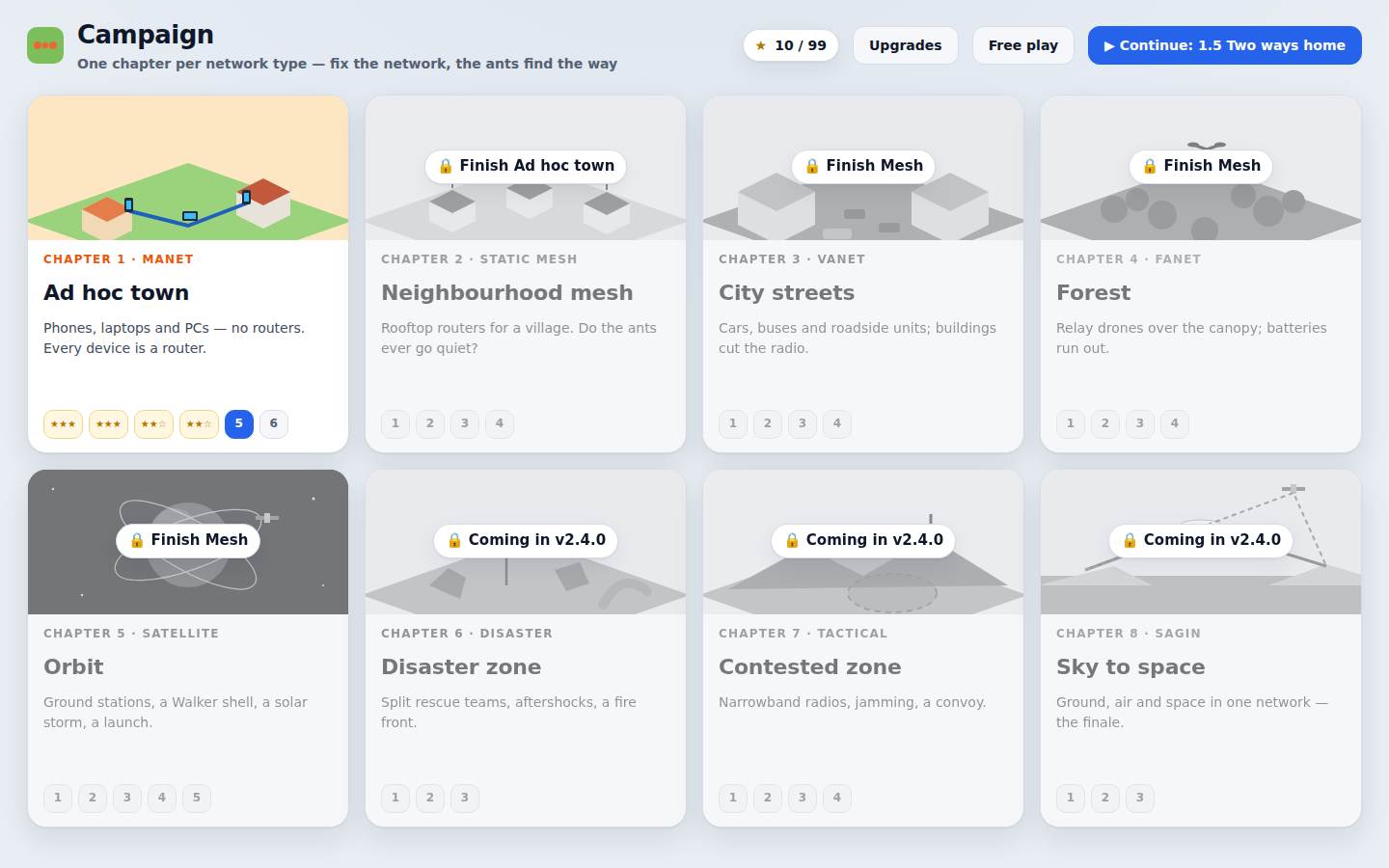
- Campaign map: a chapter-select screen in the city-builder style. Each chapter is an illustrated tile, with stars per level and locked chapters greyed out.
- Level format: levels are data, extending
missions-data.js. Each one holds the world script, budget, device palette, objectives, hazards, hints and debrief links. - Build palette: the Build tool becomes a device palette with costs; the budget is shown in the status bar.
- Art: the new device sprites (laptop, PC, router, ranger radio, sensor post, vehicle, mast, ground station, HAPS) go beside the existing phone, drone, car and satellite. They are procedural canvas art, no image assets, as today. Terrain needs canopy, a fire front, jam fields and ridges.
- Accessibility: the existing axe gate (day and night). Every level must be playable by keyboard; placement accepts the selected-node arrow keys.
- Translations (#622): all text goes through a string layer from the first campaign level, so briefings and debriefs are never hard-coded in English. Portuguese (pt-BR) is the first second language.
- Offline and size budget (#624): the game is cached for offline use (classrooms with poor Wi-Fi), and CI fails if the game download grows past its budget (starting at 512 KB raw / 160 KB gzipped; 378 KB raw today).
7. User interface
The current page is a city-builder desk: windows around a map, made for exploring a sandbox. A campaign needs a game UI: - the map fills the screen; - the player always knows the goal, the budget and the clock; - everything else comes in only when needed.
The sandbox keeps today's desk layout, as the "Free play" mode.
Screens
flowchart LR
    T["<b>Title</b><br/>Continue · Campaign ·<br/>Free play · Learn more"] --> M["<b>Campaign map</b><br/>4 chapter tiles,<br/>levels + stars"]
    M --> B["<b>Briefing card</b><br/>story · goal · budget ·<br/>devices · Start"]
    B --> L["<b>In-level HUD</b><br/>full-screen map"]
    L --> D["<b>Debrief</b><br/>stars · what you saw ·<br/>measured result · Next"]
    D --> M
    M --> U["<b>Upgrades</b><br/>gated mechanisms,<br/>each with its A/B"]
T --> F["<b>Free play</b><br/>today's sandbox desk"]- Title. A full-bleed live scene with ants walking a trail in the background. It offers four buttons:
- Continue (the last level, highlighted);
- Campaign;
- Free play;
- Learn more (the docs).
This replaces today's welcome card on the front page. - Campaign map. One illustrated tile per chapter, eight in all: Ad hoc town → Mesh → City streets / Forest / Orbit → Disaster → Contested → Sky to space. - Each tile shows its levels as stops on a path, with stars per level. - Locked chapters are greyed out, with "finish Ad hoc town to unlock" or "coming in v2.4.0". - A total-stars counter sits at the top. - Briefing card. A modal over the frozen level. It shows: - one line of story ("The café's Wi-Fi died; two friends want to call"); - the goal, written as a checklist; - the budget; - the device cards on offer; - Start.
The game starts paused in Plan phase, so the player can place devices before the clock runs. - In-level HUD. Described below. - Debrief. The stars animate in, with three lines: - what happened ("the reactive ants found your laptop relay in 38 ms"); - the mechanism, with a link to its doc page; - the measured result on the real simulator, with a link to the results page.
Buttons: Retry, Next level, Map. - Upgrades. A card grid of the gated mechanisms. Each card shows: - what the mechanism does; - the measured A/B number; - which chapters it helps; - an on/off toggle per level.
In-level HUD
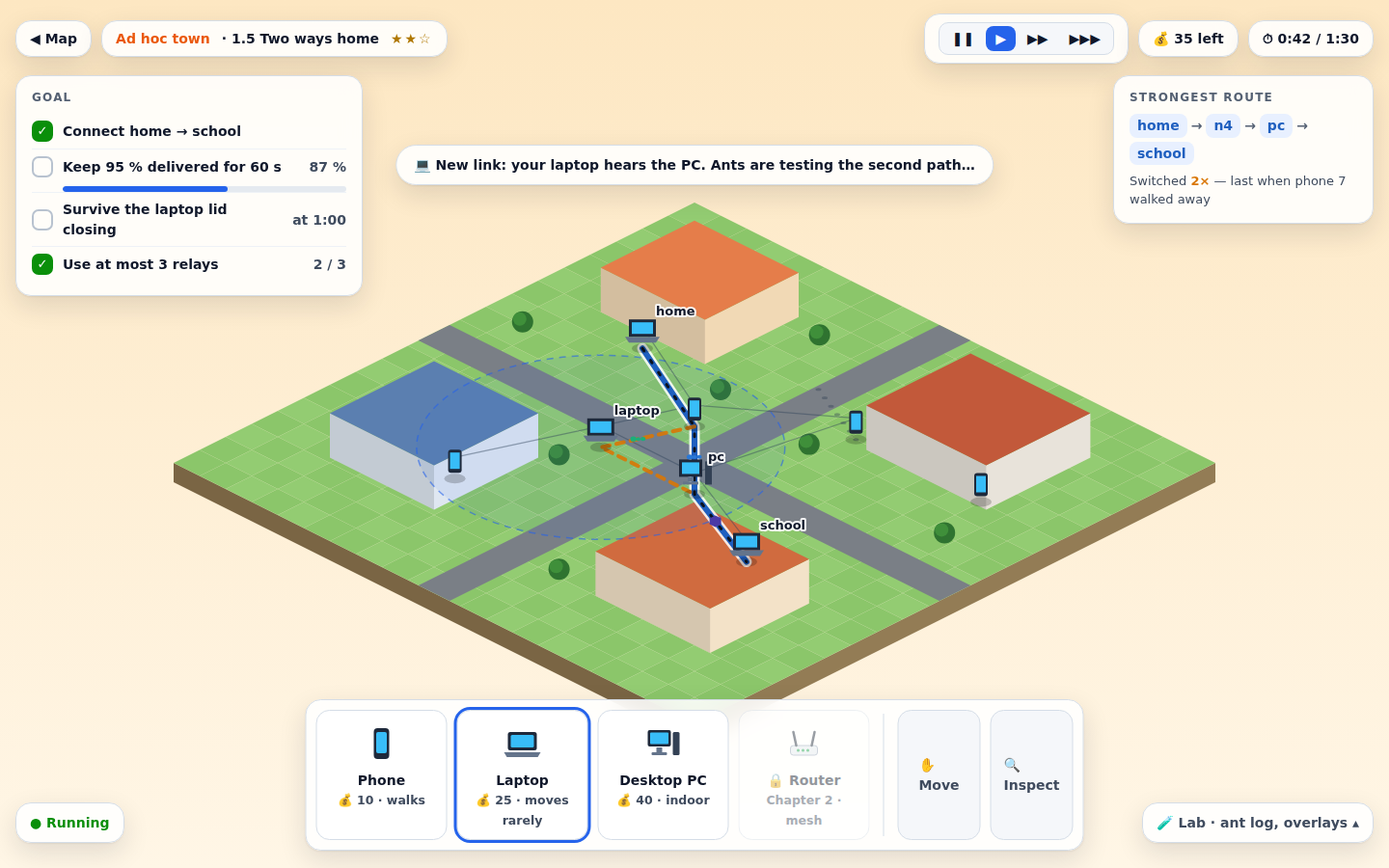
┌──────────────────────────────────────────────────────────────────────────┐
│ ◀ Map   Ad hoc town · 1.4 The café ★★☆   ⏸ ▶ ▶▶      💰 120   ⏱ 0:42 / 1:30 │  top bar
├──────────────────────────────────────────────────────────────────────────┤
│ ┌Goal───────────────┐                                    ┌Strongest route┐│
│ │✓ connect A → B    │                                    │ A→n4→n9→B     ││
│ │◻ 95 % for 60 s 87%│          full-screen map           │ switched 2×   ││
│ │◻ ≤ 3 relays   2/3 │                                    └───────────────┘│
│ └───────────────────┘                                                     │
│                                                                           │
│   toast: "Phone 7 walked out of range. Repair ants are on it."            │
├──────────────────────────────────────────────────────────────────────────┤
│ [📱 Phone 10] [💻 Laptop 25] [🖥 PC 40] [📶 Router 60]   │ ✋ Move │ 🔍 Inspect │  device dock
└──────────────────────────────────────────────────────────────────────────┘
- Top bar:
- back to the map;
- the level name;
- live stars (the score the player would get if the level ended now);
- speed controls;
- the budget;
- the level clock.
- Goal tracker (top left): the objectives as a checklist, each with a live progress value. When an objective is met it ticks green with a short animation.
- Route card (top right): the strongest pheromone route as a hop chain, plus a switch counter. It flashes amber when the route switches, the same signal as on the map.
- Device dock (bottom): device cards with icon, name and cost.
- Drag a card onto the map, or tap a card and then tap the map.
- Cards the player cannot afford are greyed out.
- While a card is dragged, its radio range shows as a ghost ring, so placement is a visual decision.
- Move and Inspect are tools at the end of the dock.
- Toasts: one at a time, in plain language, each tied to an event ("Phone 7 walked out of range").
- Inspector: a slide-in panel when a device is tapped:
- its routing table;
- "moving / standing still";
- its battery, if it has one;
- a Remove button that refunds part of the cost.
- The ant log and the overlays move into a collapsible "Lab" drawer. They are for the curious and stay out of the way.
Feel
- Feedback for every action. Placing a device pulses its range ring; a new link draws in; reaching an objective plays a short chime. Sound is off by default, with a toggle.
- Plan / Run phases. The clock waits until the player presses Run, then shows "Running". The pause between waves of hazards is the Adapt moment.
- Readable at a glance. Status is never shown by colour alone; every status also has a shape or a symbol, as today.
- Mobile first-class:
- the dock becomes a bottom sheet;
- goal and route cards collapse to chips;
- touch: drag to place, pinch to zoom, two-finger pan.
- Accessibility:
- keyboard: the number keys pick a device; the arrow keys move the placement cursor; Enter places;
- screen readers get a live region for toasts;
- the axe gate covers every new screen, by day and by night;
- motion is reduced when the reader asks for it (
prefers-reduced-motion). - Style: it continues the modern look shipped in #558 (cards, pills, glass), with a chapter colour per chapter:
- Ad hoc town: warm orange;
- Mesh: teal;
- City streets: slate;
- Forest: green;
- Orbit: indigo;
- Disaster: red;
- Contested: amber;
- Sky to space: sky blue.
The mockups below show the campaign map and the in-level HUD.
Mockups
Static mockups, not the implementation. Both are rendered from a standalone HTML file in the repository's style.
8. Tests
- Smoke (
web/test/smoke.mjs): one level per chapter played to the end with scripted input, as mission 2 is today. - Parity: every new adapter feature is exercised by a built-in scenario, so the native-vs-WASM trace gate covers it.
- Fairness check: each level's par solution (the designer's placement) must clear its objective on 5 seeds, so a level is never impossible on an unlucky seed.
9. Release mapping
| release | learn-site work |
|---|---|
| v2.2.0 | the game UI (title, campaign map, briefing, in-level HUD with device dock, debrief; the sandbox kept as Free play); campaign engine (level format, budget, objectives); device classes + per-node range in the adapter; Chapter 1: Ad hoc town (absorbs the Academy) and Chapter 2: Neighbourhood mesh; translations (pt-BR first); offline play and the size budget |
| v2.3.0 | Chapter 3: City streets, Chapter 4: Forest, Chapter 5: Orbit (the three families already measured), with attenuation zones, battery, fixed-route mobility, ground stations and the orbit binding; the upgrades screen, wired to the gated mechanisms that ship in v2.3.0; the classroom pack (lab worksheets built on the missions) |
| v2.4.0 | Chapter 6: Disaster zone, Chapter 7: Contested zone (7.1–7.3) and Chapter 8: Sky to space: the same release as the disaster/tactical and SAGIN families they draw on |
| v3.0.0 | Contested level 7.4 and the Shield upgrade, on the security profile |
| v3.3.0 | Chapter 9: Red team. The player places attackers (blackhole, wormhole, Sybil, pheromone poisoner) to break a working network, then switches defences on and watches delivery recover. Every attack and defence is a real gated mechanism from v3.0.0–v3.3.0. |
Issues
| work | issue |
|---|---|
| game UI | #566 |
| campaign engine | #567 |
| device classes (per-node range) | #568 |
| scenario features, chapters 3–5 | #575 |
| scenario features, chapters 6–8 | #582 |
| upgrades screen | #579 |
| Ch 1 Ad hoc town · Ch 2 Mesh | #569 · #570 |
| Ch 3 City streets · Ch 4 Forest · Ch 5 Orbit | #576 · #577 · #578 |
| Ch 6 Disaster · Ch 7 Contested · Ch 8 Sky to space | #583 · #584 · #585 |
| level 7.4 + Shield | #590 |
| Ch 9 Red team | #602 |
| translations (pt-BR first) | #622 |
| offline play + download-size budget | #624 |
| classroom pack (lab worksheets) | #623 |
Each chapter lands with the release that measures its network type. That way every debrief links to a measured page, not a promise.